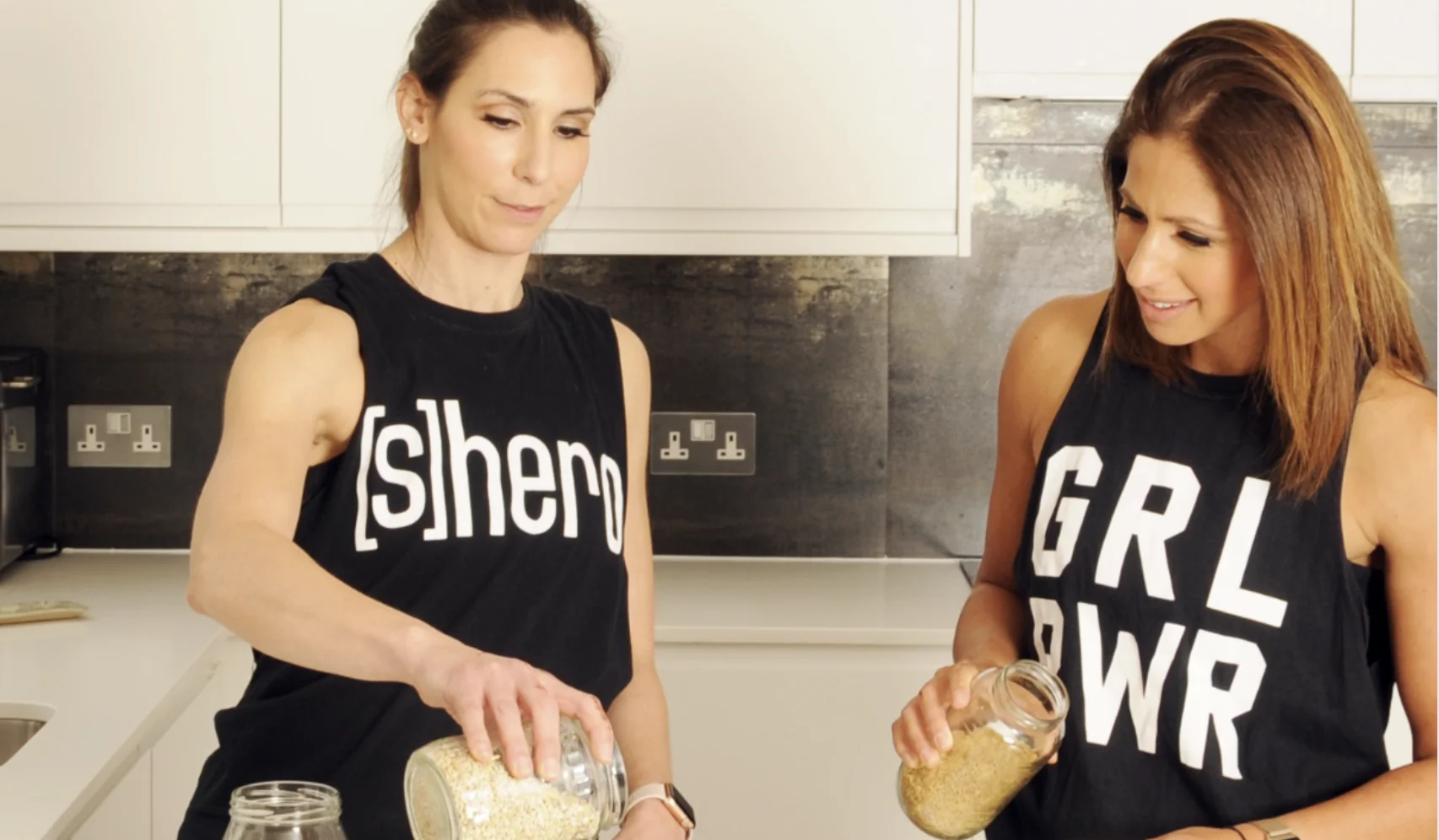
Body recomposition after 40: why the scales won't show what is actually changing
Body recomposition is losing fat while holding onto muscle, and it's the change most women over 40 actually want. Anna and Charlotte on why the scales are the worst tool for spotting it, what drives it, and how to tell it's working.
By Anna & Charlotte · MNU-Certified Nutritionists · Level 3 Personal Trainers
Published 20 September 2026 · Updated 20 September 2026

TL;DR
Body recomposition means losing fat while holding onto, or building, muscle at the same time. Because both tissues weigh something, the two changes can cancel each other out on the scales for weeks while your shape, your measurements and your strength all move. It matters more after 40 because lean mass is already declining through the menopause transition, so protecting muscle stops being a bonus and becomes the job. What drives it is unglamorous and consistent: eat enough, 30g of protein with every meal, lift two or three times a week, walk daily, sleep. And you confirm it with a tape measure, how your clothes fit and what you can lift, rather than with a morning weigh-in. Weight flat, waist down, load up is a pattern, and the pattern is the evidence.
Key takeaways
- Body recomposition is fat going down while muscle stays put or goes up. It's the change most women over 40 are actually after, and the scales are the worst tool for spotting it
- Because you're swapping one tissue for another, your total weight can sit still for weeks while your shape, your measurements and your strength all move
- After 40 it matters more: lean mass is already declining through the menopause transition, so protecting muscle is the work rather than a side effect
- The drivers are boring and they don't change: eat enough, 30g of protein per meal, strength train two or three times a week, walk, sleep
- Less food plus more cardio is the one popular combination that reliably works against recomposition, because neither half defends muscle
- Weight flat, waist down, load up is the confirmation pattern. Any one of those alone is ambiguous. All three together is recomposition, not a stall
You've been training properly for a couple of months. Your jeans do up differently. You carried the shopping in from the car in one trip without thinking about it. And the scales say more or less what they said two months ago.
That isn't necessarily a stall. Very often it's body recomposition, and it's the thing women in their 40s ask us about most once they've started doing the right things and still can't find the proof in the one number they were taught to check.
Here's the short version. Body recomposition means losing fat while holding onto the muscle you've got, or building a bit more, at the same time. Two things moving in opposite directions. The scales add them together and hand you the total.
What is body recomposition, actually?
Your weight isn't an ingredient. It's a total.
Everything you're made of goes into it: bone, water, organs, the sandwich you had at one o'clock, fat, and muscle. A set of bathroom scales can't separate any of that out. They give you one figure and leave you to guess what moved.
For most of your life that was good enough, because when weight went down it was mostly fat going down and nobody asked hard questions. Recomposition breaks the assumption. If a kilo of fat comes off and most of a kilo of muscle goes on over the same few weeks, the total barely twitches. You've changed. The number hasn't.
Your weight is a total. Body recomposition changes what's inside the total, not the total itself.
And the two tissues don't take up the same room. Muscle is denser than fat, so swapping some of one for the other makes you smaller without making you lighter. That's why the tape measure and the jeans notice first, sometimes weeks before anything else does.
This is the change aceSTRONG, our 12-week strength programme for women over 40, is built to produce. Not a smaller number in a fortnight. A different body composition, arrived at slowly enough that you get to keep it.
Why this matters more once you're past 40
Because you're not starting from neutral any more.
Lean mass declines through the menopause transition, and research following middle-aged women through it found measurable drops in lean body mass and thigh muscle tied to menopausal status rather than to ageing alone. That's happening in the background whatever you do about it.
So at 30, keeping your muscle while you lose fat was a nice bonus. At 47 it's the whole job. Muscle is the tissue doing most of your resting energy burn, it's what keeps you able to carry, lift and get up off the floor easily in twenty years' time, and it is the part of your body composition you have the most say over. You can't vote on your hormones. You can absolutely decide what's on your plate and whether you pick something heavy up three times a week.
It's not you. It's the approach you've been given.
So what actually drives it?
Four things, and none of them are exciting. That's rather the point: the unexciting version is the one still standing when life gets busy.
Eat enough
For most women who've been dieting on and off for twenty years, the first thing we do is put food back in.
You can't build or protect muscle on fumes. A long, deep deficit takes muscle off alongside the fat, which is the exact opposite of what recomposition needs. Somewhere near maintenance, or a modest deficit you barely notice, does far more for your body composition in the long run than a hard cut does in the short one.
Get the protein in
Protein is what lets your body hold onto muscle while fat is coming off, and it's the thing women under-eat most. Pairing decent protein with strength work is about as consistent a finding as this field has, with meta-analyses repeatedly showing the two together protect and build lean mass.
Three habits. The first one is doing most of the heavy lifting here.
- 01
30g of protein with every meal
- 02
500ml of water with every meal
- 03
No food after dinner
We bang on about protein a lot, and this is why. If you want the reasoning behind the number, it's all in why 30g of protein with every meal.
Lift something, two or three times a week
This is the signal that tells your body the muscle is worth keeping. Without it, a deficit has no reason to spare it.
Two or three sessions a week, getting gradually heavier over time, is enough. Not five. Not an hour and a half. Where to start with strength training after 40 walks through the beginning, including how to do it at home with a pair of dumbbells.
Sleep, walk, and give it longer than three weeks
Recomposition is slower than fat loss alone, because you're asking your body to do two jobs at once. Sleep is where the recovery actually happens, walking is the movement that doesn't bite back, and the honest bit is that this needs longer than the three weeks most plans get before they're abandoned.
The combination that works directly against all of this is also the most popular one going: less food, more cardio. Neither half defends a gram of muscle. We've unpicked that properly in why 'eat less, move more' backfires for women over 40.
How do you know it's working?
This is the bit that makes the difference between carrying on and quietly giving up halfway through, so it's worth being deliberate about it.
You're looking for a pattern, not a single signal. Any one of these on its own is ambiguous. Together they're evidence.
Weight flat, waist down, load up. That combination is recomposition, and it is not a plateau, however much it looks like one from the bathroom floor.
The reverse is worth naming too, because we'd rather you could tell the difference. If the weight is flat and nothing else is moving either, your measurements are the same and your training hasn't progressed in a month, that's a genuine plateau and something needs changing. The tape measure and your training log settle the question. The scales never could, which is the broader argument we made in why the number on the scales isn't the whole story.
How we coach this
We're Anna and Charlotte, MNU-certified nutritionists and qualified trainers, and mums in our 40s doing this alongside everyone else.
What we do with a woman who's recomposing is mostly hold her nerve for her. We get her eating properly, usually more than she expects. We get 30g of protein into every meal. The training plan is strength work, three sessions a week, refreshed every four weeks so the training keeps moving on rather than settling. And at the weekly check-in we read the whole picture together, measurements, training, energy and how the week actually felt, so that a flat week on the scales gets read correctly instead of being taken as a verdict.
That's the practical difference between a real coach and an app. An app sees a flat number and nudges you to eat less. A person who knows your training and your measurements sees a flat number and tells you to carry on, because your body is changing underneath it.
If you want the fuller picture of what midlife change involves, the guide to body transformation for women over 40 walks through what shifts and what holds.
Where to start this week
Not with a new plan. With a baseline you can actually check yourself against.
Take your waist and hip measurements today and write them down. Write down what you lifted this week and for how many reps. Then leave the scales alone for a month and look at all three together when you come back. You'll have something the number on its own was never able to give you.
If you'd rather not do it on your own, come and meet the women in the free aceLIFESTYLE community and see how we coach before you decide anything. When you want a programme to follow, aceSTRONG is 12 weeks of strength training for £99, one-off. And if you'd like your own plan and a coach checking in with you, 1-to-1 personal training starts with a free discovery call so you can decide with your eyes open.
Frequently asked
What is body recomposition?
It's losing fat while holding onto the muscle you already have, or building a little more, at the same time. Most people think of weight loss as one thing going down. Recomposition is two things moving in opposite directions at once, which is why the scales handle it so badly. Your weight is a total. Recomposition changes what's inside the total rather than the total itself, so your shape, your measurements and your strength can all change while the number barely shifts.
Can you lose fat and build muscle at the same time in your 40s?
Yes, and it's a realistic thing to aim for, particularly if you've not done much structured strength work before. The conditions that make it possible are the same three every time: eating enough rather than dieting hard, getting plenty of protein across the day, and lifting something a few times a week. Progress is usually slower and steadier than the before-and-after marketing suggests, which is precisely why it survives holidays, bad weeks and real life.
How do I know if I'm recomposing or just stuck?
Look for the pattern rather than any single signal. If your weight is flat but your waist measurement is coming down, your clothes fit differently and the weights you're lifting have gone up over the same few weeks, that's recomposition. If the weight is flat and nothing else is moving either, your measurements are the same and your training hasn't progressed, that's genuinely a plateau and something needs to change. The tape measure and your training log settle it. The scales on their own can't.
Do I need to be in a calorie deficit for body recomposition?
Usually you'd be somewhere near maintenance or in a modest deficit rather than a big one. The mistake we see most is women trying to recompose on the same aggressive deficit they've used for years, which takes muscle off at the same time as fat and leaves them smaller and weaker rather than leaner. For most women who've been dieting on and off for twenty years, the first move is eating more, not less, and getting the protein up before touching anything else.
Does cardio help with body recomposition?
Walking does, and it's the bit of cardio we'd protect above all others. It's easy to recover from, it doesn't leave you ravenous and it adds up quietly across a week. Adding more hard cardio classes on top of an already busy life rarely helps, because it doesn't defend a single gram of muscle and it usually makes you hungrier and more tired. If you're only going to add one thing to your week, make it strength training, then walk around it.