Body Transformation for Women 40+: What Actually Works in Midlife
Most body-transformation programmes weren't built for women in their 40s. Here's what actually works, coached by MNU-certified women in NW London, online from anywhere.
If you're a woman in your 40s or beyond, chances are you've had this thought:
“I'm doing what I used to do… so why isn't it working anymore?”
You're eating well. You've tried being stricter. You've added more cardio. You've promised yourself you'll be more consistent this time.
And yet the results feel slower, harder, or simply don't come in the same way they used to.
That can be incredibly frustrating.
But for many women, this isn't about a lack of discipline or motivation. Midlife brings real changes, in hormones, body composition, recovery, sleep, stress, and the practical demands of life, that can make old strategies harder to sustain and less effective.
It's not you. It's the approach you've been given.
Most body-transformation programmes weren't built for women in their 40s. They were built for 25-year-olds with two hours a day and a metabolism that forgives them. The follow-up on the “Biggest Loser” contestants six years after the show found their resting metabolic rates still suppressed by around 500 calories per day below predicted, with 13 of 14 having regained weight.[1]Your body defends itself against restriction. That isn't a moral failing. It's biology.
That doesn't mean transformation is off the table. It just means the approach may need to change.
At ace, we work with women 40+ every day who want to feel stronger, leaner, more energetic, and more in control of their bodies, not through extremes, but through habits and training strategies that actually fit real life.
It's exactly what aceSTRONG, our 12-week strength programme for women 40+ is built to do.
Here's what tends to work.
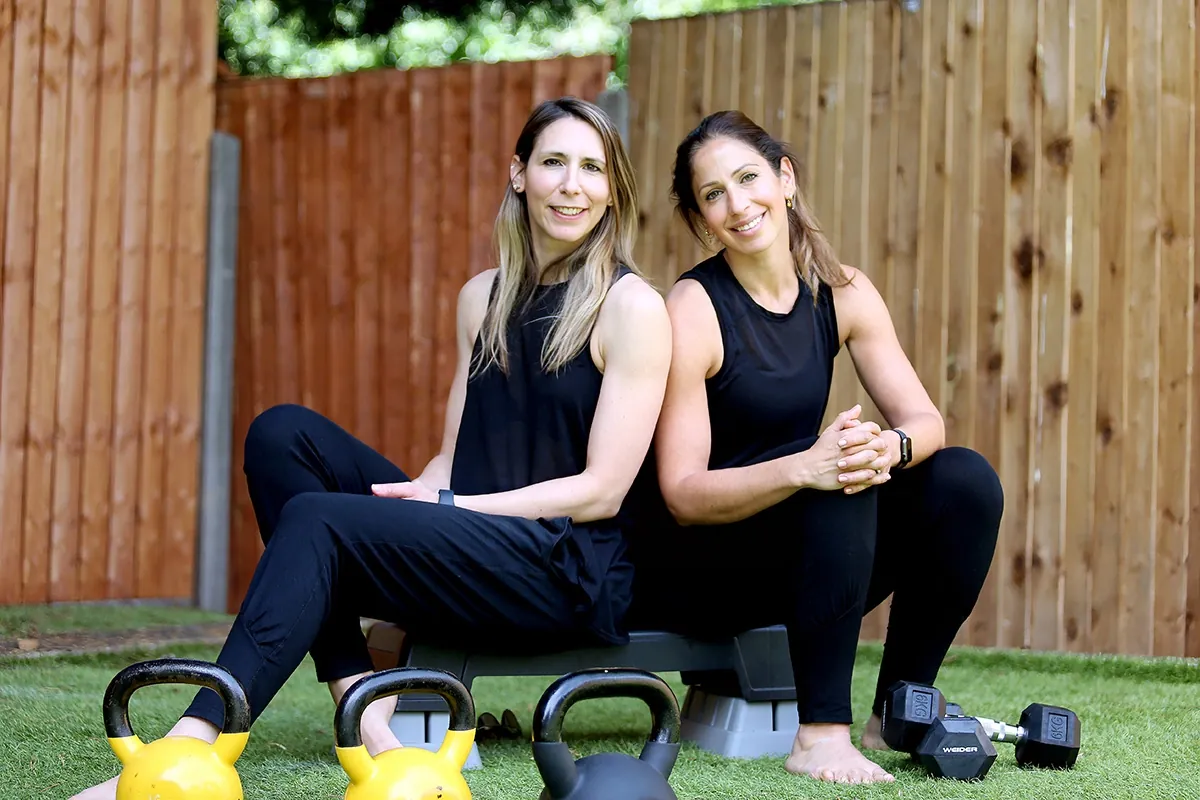
“We understand your life, because we're living it too. As busy women in our 40s, we know how challenging it can be to prioritise yourself.”
Anna & Charlotte, ace founders
Why transformation feels different in your 40s
Three things make mid-life transformation different from anything you've tried before. Most programmes ignore all three.
1. Your body is changing, and your approach may need to change with it
As women move through their 40s and into the menopause transition, shifting levels of oestrogen and progesterone can influence far more than just your cycle. Prospective research has documented that the transition itself causes around a 50 kcal/day drop in resting energy expenditure, alongside a shift toward central (abdominal) fat deposition, independent of chronological ageing.[2] Recovery takes longer. Sleep affects everything. Stress hits harder.
This isn't a moral failing.
It's biology.
This doesn't mean your metabolism has suddenly “broken”. But it may help explain why the strategies that once felt effective, doing more cardio, eating less, pushing harder, can start to feel far less rewarding. Sustained energy deficits raise cortisol, suppress reproductive hormones, and lower resting metabolic rate further still.[1] You end up doing more, seeing less, and feeling more exhausted than when you started.
The answer usually isn't to double down on what used to work. It's to adapt.
2. You're carrying a lot more than your younger self was
Most transformation programmes are built as though your life is empty. Train five times a week. Prep every meal. Prioritise yourself above everything else.
For most women in this stage of life, that simply isn't realistic. You may be managing work, children, ageing parents, relationships, a household, social commitments, interrupted sleep, and the general mental load of being the person who keeps everything moving.
That matters.
Because even the “perfect” plan will fail if it doesn't fit your actual life. This is one of the biggest reasons women blame themselves unnecessarily. The problem often isn't motivation. The problem is trying to follow a plan designed for someone with completely different circumstances.
3. Quick fixes are still being sold, but they rarely solve the real problem
The fitness industry has always been good at selling urgency. Lose weight fast. Get results in 30 days. Burn more. Eat less. And yes, extreme approaches can absolutely create short-term change.
But short-term results and long-term transformation are not the same thing. In the largest meta-review of long-term diet outcomes, the majority of dieters regained all the weight they lost within four to five years, and one-third to two-thirds regained more than they lost.[3] Restrictive cycles predict gain, not loss.
For women 40+, the bigger question is: can you sustain the approach once life gets busy, stressful, social, hormonal, or unpredictable? Because that's where most plans fall apart.
The women we coach rarely struggle because they don't know what to do. They struggle because they've spent years trying approaches that rely on perfection, intensity, or constant willpower. Real transformation tends to come from repeatable behaviours, not heroic effort.
What actually works: the three pillars
A real body transformation for women 40+ runs on three things, in this order. Skip any one and the work doesn't hold.
Pillar 1: Strength training that builds, not punishes
If there's one thing we'd encourage women 40+ to prioritise, it's strength training. Not because everyone needs to become obsessed with lifting weights. Not because cardio is “bad”. But because muscle matters.
As we get older, maintaining muscle becomes increasingly important, not just for how we look, but for how we function, recover, and feel. Muscle is metabolically active: it releases signalling proteins (called myokines) that regulate fat oxidation, glucose handling, and bone metabolism systemically.[4] Strength training supports lean muscle mass, bone health, metabolic health, insulin sensitivity, mobility, and long-term independence.[5]
From a body composition perspective, it changes the game. Many women are focused entirely on losing weight. What often matters more is what that weight is made up of. Losing body fat while maintaining (or ideally building) muscle creates a very different outcome to simply chasing a lower number on the scales.
This is why endless cardio often leaves women frustrated. You may burn energy in the moment, but if your training isn't supporting muscle, strength, and recovery, it's rarely the most effective long-term strategy.
The good news? You don't need to live in the gym. The UK Chief Medical Officers recommend muscle-strengthening activities on at least two days per week,[6] and for most women, two to four well-programmed strength sessions a week is more than enough to create meaningful progress. The key is consistency, progression, and training in a way that works with your recovery, not against it.
And the safety question is settled. In postmenopausal women with low bone density, eight months of supervised heavy resistance training produced significant gains in lumbar spine bone mineral density and zero fractures, overturning the long-standing assumption that fragile bones can't tolerate heavy load.[7]
Pillar 2: Nutrition that works in real life
This is where many women assume they need to become stricter. In reality, most need to become more consistent.
Good nutrition in midlife doesn't mean eating “perfectly”. It means having a structure that still works when life gets busy. That's why in our coaching, we focus on simple habits that create consistency rather than relying on constant decision-making. We call them the aceRULES:
Three habits. Same three, every day. They survive holidays, bad weeks, and the school run.
- 01
30g of protein with every meal
- 02
500ml of water with every meal
- 03
No food after dinner
Three habits. No banned foods. No obsessive calorie counting. Rules that work whether you're at home, at work, on holiday, or eating dinner with your kids.
Protein with every meal.Protein becomes even more important as we get older. It supports muscle maintenance, recovery, satiety, and body composition, and many women simply aren't eating enough of it. That doesn't mean every meal needs to be complicated. Greek yoghurt. Eggs. Chicken. Fish. Cottage cheese. Protein shakes. Simple works. The 30g target isn't arbitrary: the International Society of Sports Nutrition recommends 0.4g of protein per kilogram of body weight per meal, distributed across roughly four meals, and notes that older adults need the upper end of that range to overcome age-related anabolic resistance.[8]
Water with every meal. Hydration sounds basic because it is. But it makes a genuine difference to energy, appetite regulation, digestion, and general wellbeing. Many women are running on coffee and hoping for the best. This rule fixes that quickly.
No food after dinner.Not because eating in the evening is inherently harmful. Because mindless evening eating is where many women quietly undo an otherwise solid day. Picking at leftovers. Biscuits with tea. Random snacks while clearing up. Creating a clear “kitchen closed” habit removes a lot of unnecessary friction.
Beyond that, some clients find calorie tracking helpful for building awareness, understanding portions, and creating structure, particularly if fat loss is the goal. But tracking is a tool, not the goal. The real aim is building eating habits you can sustain. Because the best nutrition plan isn't the most restrictive one. It's the one you can still follow on a stressful Tuesday, during the school run, or when life feels full.
Pillar 3: Support makes consistency easier
Doing this alone is hard. Not because you're incapable. Because behaviour change is genuinely harder in isolation.
When motivation dips (and it will), when life gets chaotic, or when progress feels slower than you hoped, it's very easy to drift back into old patterns. That's where support matters.
Research consistently shows that structured support improves adherence and long-term outcomes in weight management and behaviour change. In a UK-based randomised controlled trial of 772 adults, a group-based commercial programme produced roughly twice the weight loss of standard primary-care advice at 12 months[9], the active ingredient being the group structure itself, not the specific diet plan.
But beyond the research, we see it every day. Women do better when they feel supported. When someone is helping them adjust the plan. When there's accountability. When they're surrounded by other women navigating similar challenges. Transformation stops feeling like a solo battle and starts feeling manageable. And that changes everything.
What realistic progress actually looks like
One of the biggest problems with transformation marketing is that it makes meaningful change look immediate. A dramatic before-and-after in 30 days. A complete body overhaul in six weeks. A promise that if you just try hard enough, everything will look different by next month.
That's rarely how real change works. Particularly in midlife.
That doesn't mean progress is slow. It means progress is cumulative.
Weeks 1-4
Building the foundations
This is where consistency matters more than visible results. You're creating structure. Meals start feeling more intentional. Protein becomes less of an afterthought. Training begins to feel like part of your week rather than something you're trying to squeeze in. You may notice better energy, fewer “what shall I eat?” moments, less grazing, more confidence in the gym, and feeling less all-or-nothing around food. What you probably won't see yet is dramatic visual change, and that's completely normal.
Weeks 5-8
Things start shifting
This is often where women start to feel the difference. You feel stronger. Weights that felt heavy in week one start moving more easily. Your routines feel less effortful. For some women, body composition changes become more noticeable: clothes fitting differently, less bloating, improved shape, better posture, more muscle definition.
Weeks 8-12
Progress compounds
This is where consistency starts paying off. Training feels familiar. Food feels less emotionally charged. Habits start doing more of the work. Physically, this is often where the more obvious changes happen: improved strength, noticeable body composition changes, better fitness, more energy, greater confidence. This is also the window where most structured strength-training programmes start to show measurable lean-mass-up / fat-mass-down recomposition when paired with adequate protein.[10] And importantly, this tends to feel sustainable.
After 12 weeks, the women who hold the change are the ones who treat it as a starting baseline, not a finishing line. Body transformation for women 40+ isn't a sprint to a goal weight; it's a shift in how you train, eat, and relate to your own body. The first 12 weeks are how you find out you can.
The bottom line
If what used to work doesn't feel like it's working anymore, that doesn't mean you've failed. It may simply mean your body, your lifestyle, and your priorities have changed.
Midlife transformation doesn't require punishment. It doesn't require perfection. What tends to work is far less dramatic:
- strength training with purpose
- nutrition that fits real life
- habits that are simple enough to repeat
- support that helps you stay consistent
Not glamorous. Just effective. And often, that's exactly what women have been missing.
Coached in NW London. Working with women everywhere.
We're Anna and Charlotte: school friends, mums, MNU-certified nutritionists, and Level 3 personal trainers. We've spent over ten years running women's groups, mostly in NW London, and we now coach women from across the UK and beyond through our Skool community app.
Running women's groups together. Most of our members stay for years, not weeks.
NW4 · Hendon · Mill Hill · Finchley · Barnet. In-person PT from our home base.
Members coaching through the Skool community app: same programme, every time zone.
Whether you're local enough to come in person or you're juggling family life from another time zone, the approach is the same: structured strength training, the aceRULES, and a small community of women doing this alongside you.
Frequently asked
How is body transformation for women 40+ different from any other transformation programme?
Three things. First, the work is built around the hormonal reality of mid-life, not the metabolism of a 25-year-old. Second, it's structured around three habits (the aceRULES) that hold up under real life, not a restrictive plan you abandon in week four. Third, you do it alongside other women in the same stage, not alone in front of an app.
Do I need to lose a lot of weight for this to be worth it?
No. The women we coach come in with goals that range from five to fifteen kilos to lose, to "I want to feel strong again," to "I want my clothes to fit how they used to." Body transformation isn't only about weight on the scale: it's about how your body composes its weight, how strong you feel, and how you relate to food. Some of our most committed members aren't focused on a number at all.
Can I do this if I'm in perimenopause or post-menopause?
Yes. This is exactly the audience the programme was built for. Strength training and adequate protein become more important during and after menopause, not less. A 2023 meta-analysis of exercise interventions in postmenopausal women found that the resistance-training subgroup produced the largest gains in lean mass and the largest reductions in fat mass and visceral adiposity. The aceRULES are designed around exactly this stage of life. We work with women in their late 40s and 50s constantly.[11]
How much time do I need each week?
Less than you think. Most of the women we coach train two to three times a week, usually 30-45 minutes per session. The nutrition side adds essentially zero time: the aceRULES are habits, not meal-prep marathons. If you can find three hours a week, you can do this. If you can find more, even better.
What if I've tried other things and they haven't worked?
Most of our members have. That's not a failure, it's data. The approaches you've tried before were probably designed for someone who isn't you. The work we do starts from where you are now: your hormonal stage, your time, your real life. Different inputs produce different outputs.
Just a room full of women who've been where you are.
The ace community on Skoolis a free space where over a thousand women like you are working through this kind of change together. You'll find recipes, the resources we mention here, and a thread you can ask questions in. Anna or Charlotte will see them. No card, no pressure, no commitment.
Or grab the free 7-day meal plan built around the aceRULES.
Lots of love,
Anna & Char x
Evidence
Eleven peer-reviewed citations directly back the substantive claims in this guide.
- [1]Fothergill E, Guo J, Howard L et al. (2016). Persistent metabolic adaptation 6 years after "The Biggest Loser" competition. Obesity (Silver Spring), 24(8), 1612-1619 · doi.org/10.1002/oby.21538 · PMID: 27136388
- [2]Lovejoy JC, Champagne CM, de Jonge L, Xie H, Smith SR (2008). Increased visceral fat and decreased energy expenditure during the menopausal transition. International Journal of Obesity, 32(6), 949-958 · doi.org/10.1038/ijo.2008.25 · PMID: 18332882
- [3]Mann T, Tomiyama AJ, Westling E, Lew AM, Samuels B, Chatman J (2007). Medicare's search for effective obesity treatments: diets are not the answer. American Psychologist, 62(3), 220-233 · doi.org/10.1037/0003-066X.62.3.220 · PMID: 17469900
- [4]Pedersen BK, Febbraio MA (2012). Muscles, exercise and obesity: skeletal muscle as a secretory organ. Nature Reviews Endocrinology, 8(8), 457-465 · doi.org/10.1038/nrendo.2012.49 · PMID: 22473333
- [5]Westcott WL (2012). Resistance training is medicine: effects of strength training on health. Current Sports Medicine Reports, 11(4), 209-216 · doi.org/10.1249/JSR.0b013e31825dabb8 · PMID: 22777332
- [6]UK Chief Medical Officers (2019). UK Chief Medical Officers' Physical Activity Guidelines (Department of Health and Social Care). Recommends adults undertake muscle-strengthening activities on at least 2 days per week · gov.uk · Physical Activity Guidelines
- [7]Watson SL, Weeks BK, Weis LJ, Harding AT, Horan SA, Beck BR (2018). High-intensity resistance and impact training improves bone mineral density and physical function in postmenopausal women with osteopenia and osteoporosis: the LIFTMOR randomized controlled trial. Journal of Bone and Mineral Research, 33(2), 211-220 · doi.org/10.1002/jbmr.3284 · PMID: 28975661
- [8]Jäger R, Kerksick CM, Campbell BI et al. (2017). International Society of Sports Nutrition Position Stand: protein and exercise. Journal of the International Society of Sports Nutrition, 14, 20 · doi.org/10.1186/s12970-017-0177-8 · PMID: 28642676
- [9]Jebb SA, Ahern AL, Olson AD et al. (2011). Primary care referral to a commercial provider for weight loss treatment versus standard care: a randomised controlled trial. The Lancet, 378(9801), 1485-1492 · doi.org/10.1016/S0140-6736(11)61344-5 · PMID: 21906798
- [10]Longland TM, Oikawa SY, Mitchell CJ, Devries MC, Phillips SM (2016). Higher compared with lower dietary protein during an energy deficit combined with intense exercise promotes greater lean mass gain and fat mass loss: a randomized trial. American Journal of Clinical Nutrition, 103(3), 738-746 · doi.org/10.3945/ajcn.115.119339 · PMID: 26817506
- [11]Khalafi M, Habibi Maleki A, Sakhaei MH et al. (2023). The effects of exercise training on body composition in postmenopausal women: a systematic review and meta-analysis. Frontiers in Endocrinology, 14, 1183765 · doi.org/10.3389/fendo.2023.1183765 · PMID: 37388207
Full reference pack covering 27 papers across all 8 substantive claims is available on request. Spot-verify all DOI/PMID identifiers at PubMed before production deploy.